Review AGIGO's security, privacy, and compliance
Enterprise AI requires a clear understanding of where processing takes place, how data is accessed, and how business actions are controlled.
The AGIGO Trust Center brings together the information your security, privacy, legal, and procurement teams need to assess the platform and its deployment.
Enterprise control at the foundation
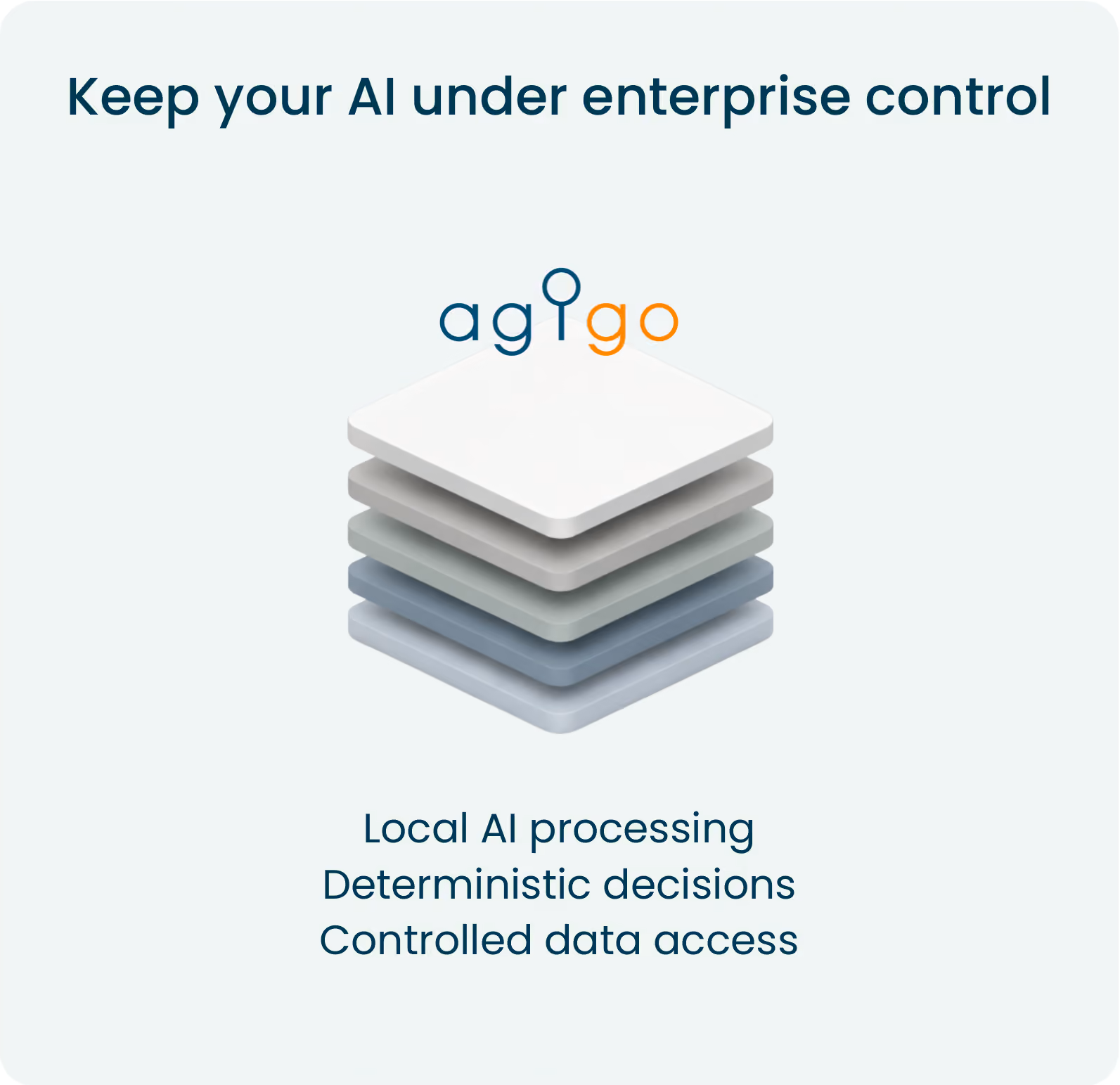
AGIGO separates conversational intelligence from the authority to decide and execute. Access and business actions follow enterprise-defined controls.
Local AI processing
Deploy the complete AGIGO platform, including all required infrastructure components, within your own enterprise infrastructure. No external AI processing services needed.

Deterministic decisions
The same verified inputs, rule version, and relevant system state produce the same decision. Explicit facts and rules provide a concrete basis for testing and reviewing business logic.
Controlled integration
The Data Access Layer mediates enterprise access. The conversational layer receives authorized information, while enterprise systems execute and store verified transactions.
Make no compromises on the operating model your enterprise requires.
Processing location, provider access, contractual responsibilities, and operational controls depend on the selected configuration.

Enterprise-controlled
Deploy the full stack on-prem or in an enterprise-controlled private environment, without external AI processing services. Your enterprise governs data access and customer communications.
Partner-hosted
A selected partner hosts the platform and provides agreed operational services. Review hosting location, administrative access, subprocessors, and responsibilities for the proposed arrangement.
AGIGO-managed
Use an isolated tenant environment managed by AGIGO. Assess the agreed hosting, processing, and support arrangements, with the option to migrate to an enterprise deployment upon request.
Customer communication channels and their transport providers remain part of the enterprise deployment's data-flow assessment.
Your data remains strictly under your authority
No customer data used by AGIGO for training
AGIGO does not use enterprise customer data or end-customer data to train its models. In the enterprise-controlled deployment, AGIGO has no access to enterprise databases.

Enterprise-governed adaptation
An enterprise may use conversation data to improve an agent's language capabilities within its own environment, subject to applicable law, required permissions, and internal policy. This does not give AGIGO access to that data.
Deployment reviews address lawful processing, authorized access, retention, logging, and customer communications. Local processing reduces external AI dependencies while preserving the enterprise's responsibility for its own data processing.
Meeting the EU AI Act requirements
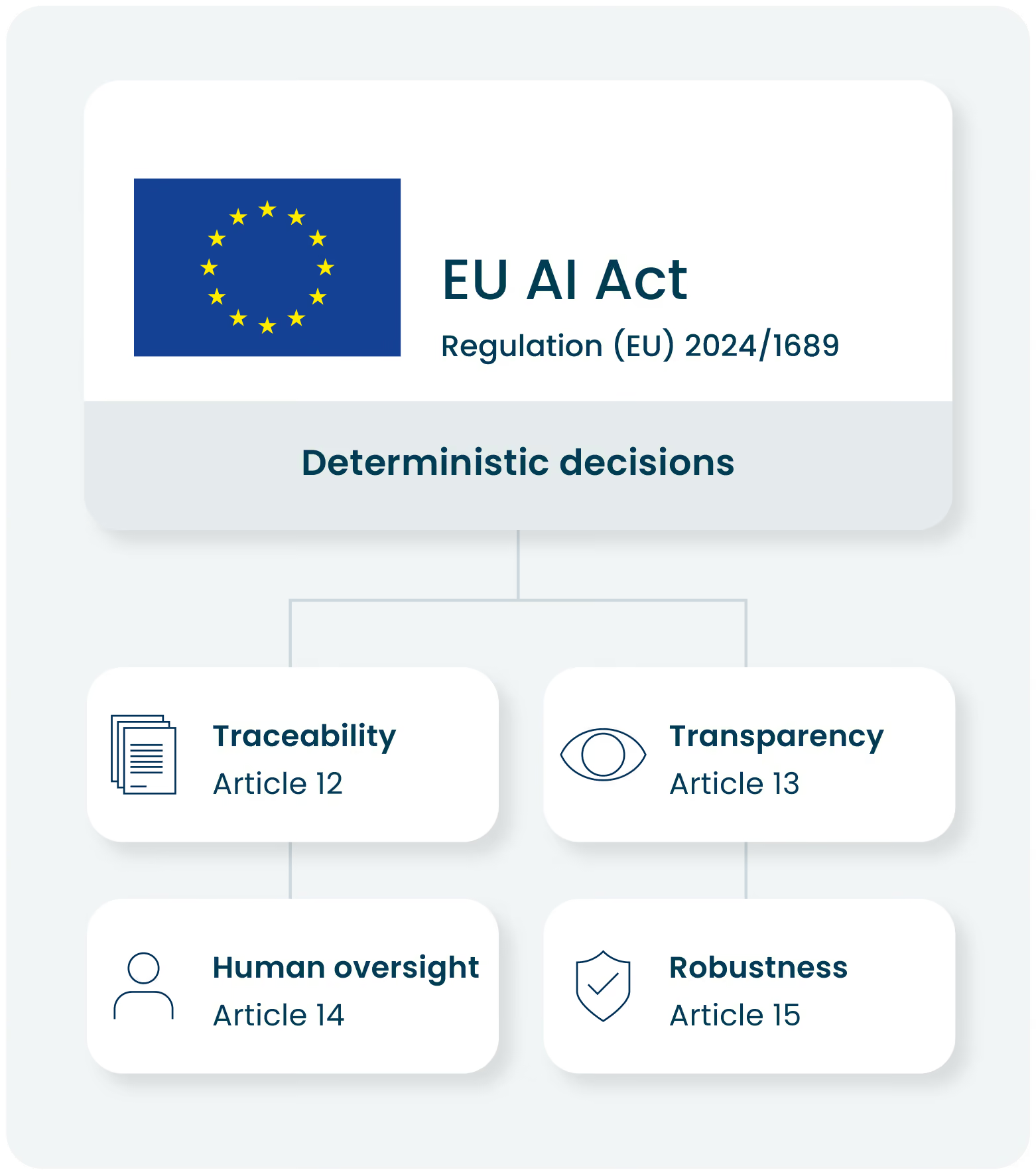
AGIGO's unique proprietary systems architecture separates conversational intelligence, deterministic decisions, and controlled execution. This provides an architectural foundation for risk reduction, traceability, transparency, and robustness. These capabilities are particularly relevant when conversational AI participates in regulated or consequential workflows.
AGIGO's design principles align well with the EU AI Act's requirements for deterministic decision-making.
Its deterministic decision engine applies defined rules to verified facts, making decisions reproducible, explainable, and subject to enterprise control. This gives enterprises a practical architectural advantage when implementing conversational AI with AGIGO in regulated and consequential workflows.
Relevant provisions include EU AI Act Articles 9, 12, 13, 14, 15, and 86. Applicable obligations depend on the intended use, risk classification, operator roles, and deployment. Deterministic decision-making supports governance. System-level validation also covers speech interpretation, input verification, oversight, and operational controls.
AGIGO is built for environments where control is essential

Banking and Financial Services
Keep sensitive customer interactions and AI processing within the enterprise environment. Apply controlled data access and verified transaction execution to support banking governance, privacy, and operational risk assessment.

Healthcare
Process sensitive conversations locally and govern access to patient-related information through enterprise-defined interfaces. Assess each workflow against applicable health privacy, security, and clinical requirements.

Insurance
Apply explicit enterprise rules to service workflows and authorized actions. Keep policyholder data under enterprise control and assess consequential uses against applicable insurance and AI obligations.

Government and Public Services
Retain control over infrastructure, data access, and service execution. Support accountable citizen interactions with a deployment architecture aligned to public-sector sovereignty and governance requirements.
A transparent view of our compliance commitments
Regulatory positions are informed by external counsel. The scope of each commitment matters when assessing a particular enterprise deployment.
Regulation or Framework
Status
Scope and Meaning
Swiss Federal Act on Data Protection (FADP)
Compliant
AGIGO's applicable company and platform obligations. Each enterprise deployment retains its own processing responsibilities.
EU General Data Protection Regulation (GDPR)
Compliant
AGIGO's applicable obligations. Enterprise processing purposes, configuration, and data flows remain part of deployment assessment.
Swiss AI Regulatory Framework
Aligned
Alignment with the developing Swiss AI regulatory framework, assessed with external counsel.
EU AI Act
Compliant
AGIGO's applicable obligations, assessed with external counsel. Use-case-specific requirements are addressed in the enterprise deployment.
HIPAA
Aligned
Architecture and control alignment for applicable healthcare deployments. Required safeguards and agreements depend on the deployment and parties' roles.
ISO/IEC 42001
Certification in Progress
AI management system certification work is underway with external advisory support.
SOC 2 Type II
Assurance Program in Progress
Work toward independent examination of controls over an observation period is underway with external advisory support.
ISO/IEC 27001
Aligned
Information security management alignment. This status does not indicate an issued certificate.
ISO/IEC 27701
Aligned
Privacy information management alignment. This status does not indicate an issued certificate.
Compliance describes applicable legal obligations. Alignment describes mapping to a framework. Certification and independent assurance involve separate evaluation processes. An in-progress status does not indicate that a certificate or report has been issued.
Information for your assessment
Enterprise assessments cover the selected deployment model, intended use, and operational responsibilities. Relevant supporting information addresses the following areas.
Architecture and data flows
Processing boundaries, customer channels, DAL interfaces, and the verified transaction path.
Security and operations
Validation, release governance, logging, handoff controls, and operational responsibilities.
Privacy and contracts
Processing roles, provider access, retention, support, and applicable data processing or subprocessor terms.

Regulatory and assurance scope
Applicable regulatory assessment, framework alignment, and current certification or assurance work.
Supporting documentation is shared with prospective enterprise customers and their authorized advisors during the assessment process, subject to confidentiality and access approval.
Clear answers for enterprise reviewers
Does AGIGO require external AI services?
No. AGIGO provides the infrastructure and tools required for an on-premises deployment, including local speech and language processing, speech synthesis, and orchestration. External AI processing services are not required in this configuration.
Does AGIGO use our data for model training?
AGIGO does not use enterprise customer data or end-customer data to train its models. Enterprise-authorized adaptation within the enterprise environment remains subject to the enterprise's permissions and policies.
Does a compliant platform make our enterprise compliant?
Enterprise compliance depends on the intended use, deployment, data processing, and operational governance. AGIGO provides a controlled architecture that supports assessment and implementation of applicable requirements.
Can we request an ISO certificate or SOC 2 report?
The status table distinguishes legal compliance, standards alignment, and work in progress. An in-progress initiative does not indicate an issued certificate or report. Request clarification of the current status and any evidence available for your review.
Can our advisors or integration partner participate?
Yes. Your enterprise can involve its chosen advisors and integration partners in reviewing data flows, mapping controls, validating workflows, and documenting operational responsibilities.
Supporting documentation is shared with prospective enterprise customers and their authorized advisors during the assessment process, subject to confidentiality and access approval.